DirectingGuide
A director's prep workflow, from script to shot list
One kitchen scene prepped end to end: the point, the beats, the floor plan and a shot list ranked by what you cannot lose, plus a one-page prep pack and a second scene to try.
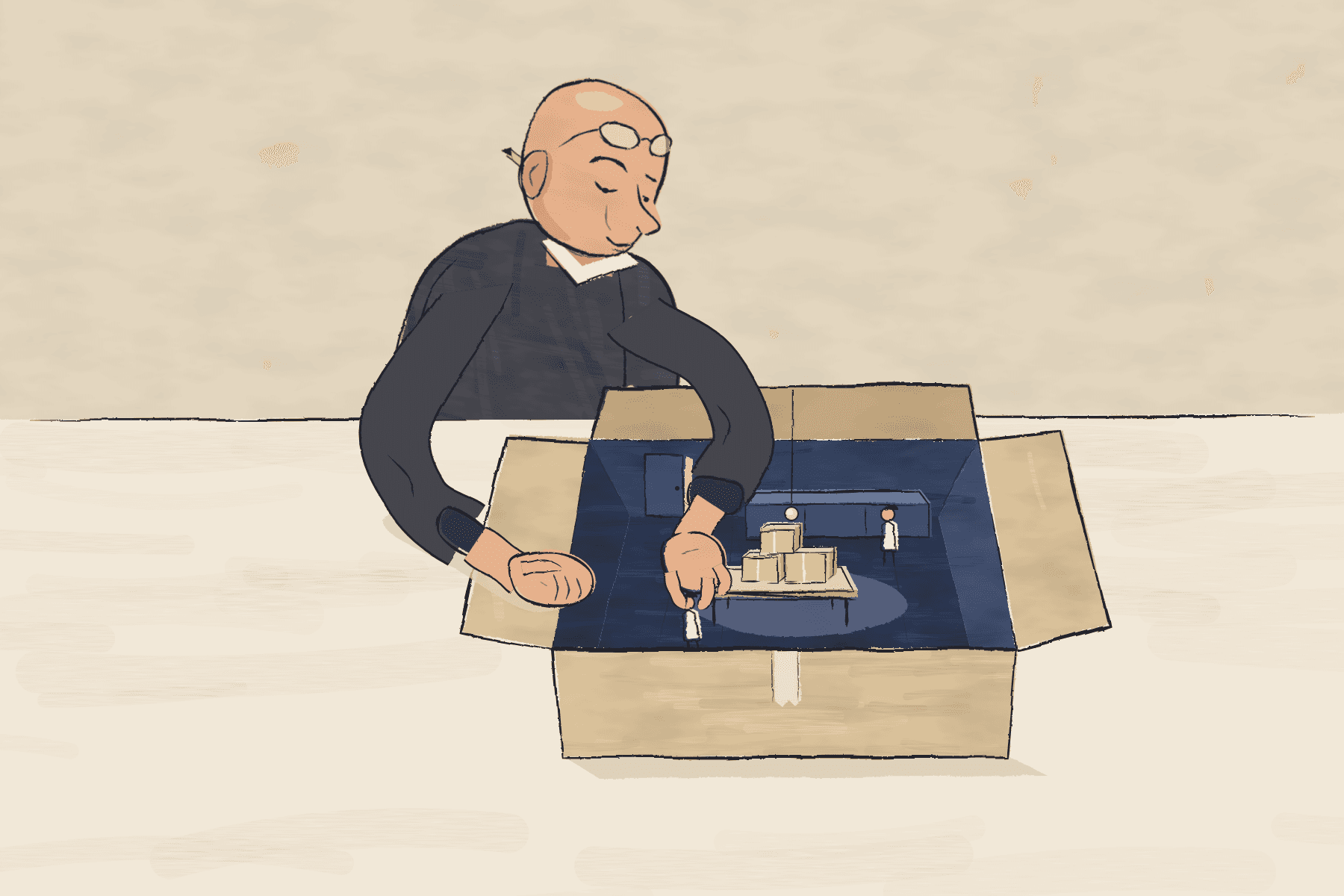
Prep a scene in this order: find its point and its turn, mark the beats, decide what the audience must see, block it on a floor plan, build a shot list from the blocking, and rank the shots so you know what to protect when the day runs short. This guide takes one short kitchen scene through all six steps, then gives you a one-page checklist and a second scene to try yourself.
The scene we'll prep
We use the same short scene as in how to break down a scene, now from the director's side. The scene, the house and the layout below are a Vitoniou teaching example, invented for this guide. It is scene 14 of the fictional short "The Key", which also appears on the sample sheet in anatomy of a film call sheet.
Nora
Dan
Nora
Dan
Nora
Dan
Nora
Dan
Nora
Dan
Nora
Dan
Nora
1. Find the point and the turn
Before any shots, write two sentences. What is this scene really about, underneath the plot? And where does it turn?
Worked example · the point and the turn (hypothetical)
- About: who gets to decide when to let go. On the surface it is about a key and a sale.
- Whose scene: Nora's. She changes tactics three times: refusal, memory, then a direct request.
- Before and after: the audience enters thinking Dan is only being practical. They leave knowing he decided without her, and that she can only ask.
- The turn: "I signed this afternoon." Everything before it is Nora hoping. Everything after it is Nora knowing.
If you cannot find a turn, the scene may not need to be a scene. Check the draft before you plan coverage for it. The same questions drive the scene breakdown page you would fill in on any scene, whatever the format.
2. Mark the beats
A beat is a stretch of the scene where one thing is being tried. Mark a new beat whenever the tactic or the balance between the characters changes. For a director, the beat map is the bridge between the script and the floor.
Worked example · beat map for scene 14 (hypothetical)
| Beat | Lines | What changes | Who drives |
|---|---|---|---|
| A. The key | "You kept the key" to "Nora." | Nora refuses the handover. Dan stays practical | Nora |
| B. The marks | "Dad's height marks" to "That's when I left." | Argument turns to memory. Dan gives a first honest answer | Nora |
| C. The ask | "You could stay" to "You held the flashlight." | Nora offers closeness. Dan resists with small facts | Nora |
| D. The signature | "I signed this afternoon" to "You'd have asked me not to." | The turn. Dan has already decided | Dan |
| E. The request | "Then I'm asking you to stay." | Nora stops arguing and asks | Nora |
3. Decide what the audience must see
Now ask the camera question for the first time, and ask it of the story, not of the room. What does the audience need to see, in an image, to understand what the dialogue never says? Keep the list short.
Worked example · the must-see images (hypothetical)
- The distance across the room at the start, with the counter and the boxes between the two of them.
- The height marks on the pantry door, because "Yours stop at fourteen" lands harder if we have seen the pencil lines.
- Dan's face at "I signed this afternoon." The turn is a reaction as much as a line.
- The key on the counter, as the last image of the scene.
These four images become your priorities in step 5. Anything else you shoot is there to support them.
4. Block it on a floor plan
Blocking is deciding where the actors stand and move, and when. Sketch the room from above first, then plan the moves from the beats. NFTS lists floor plans and shot lists among the parts of its director prep training, and the DGA has run a lab on blocking and shot listing a scene before the shoot, so these are common parts of prep training.
The room here is invented: a hallway door on the right wall, a pantry door at the back left, a counter along the back wall and a worktable with boxes in the middle. The blocking follows the beats and the images above.
Worked example · blocking by beat (hypothetical)
| Beat | Nora | Dan | Why |
|---|---|---|---|
| A | Enters from the hallway door and stops just inside | Behind the worktable, taping | The room separates them |
| B | Crosses to the pantry door and touches the marks | Stays at the worktable, not looking up | Memory pulls her away from him, and he refuses to follow |
| C | Comes back and leans on the end of the worktable, close to him | Keeps working, then slows | The distance closes as she asks |
| D | Stays where she is | Stops taping and steps back from the table | He moves away at the moment he tells her |
| E | Crosses to the near end of the counter and sets the key down | Moves to the far end of the counter | The key sits between them, and the plan ends on that image |
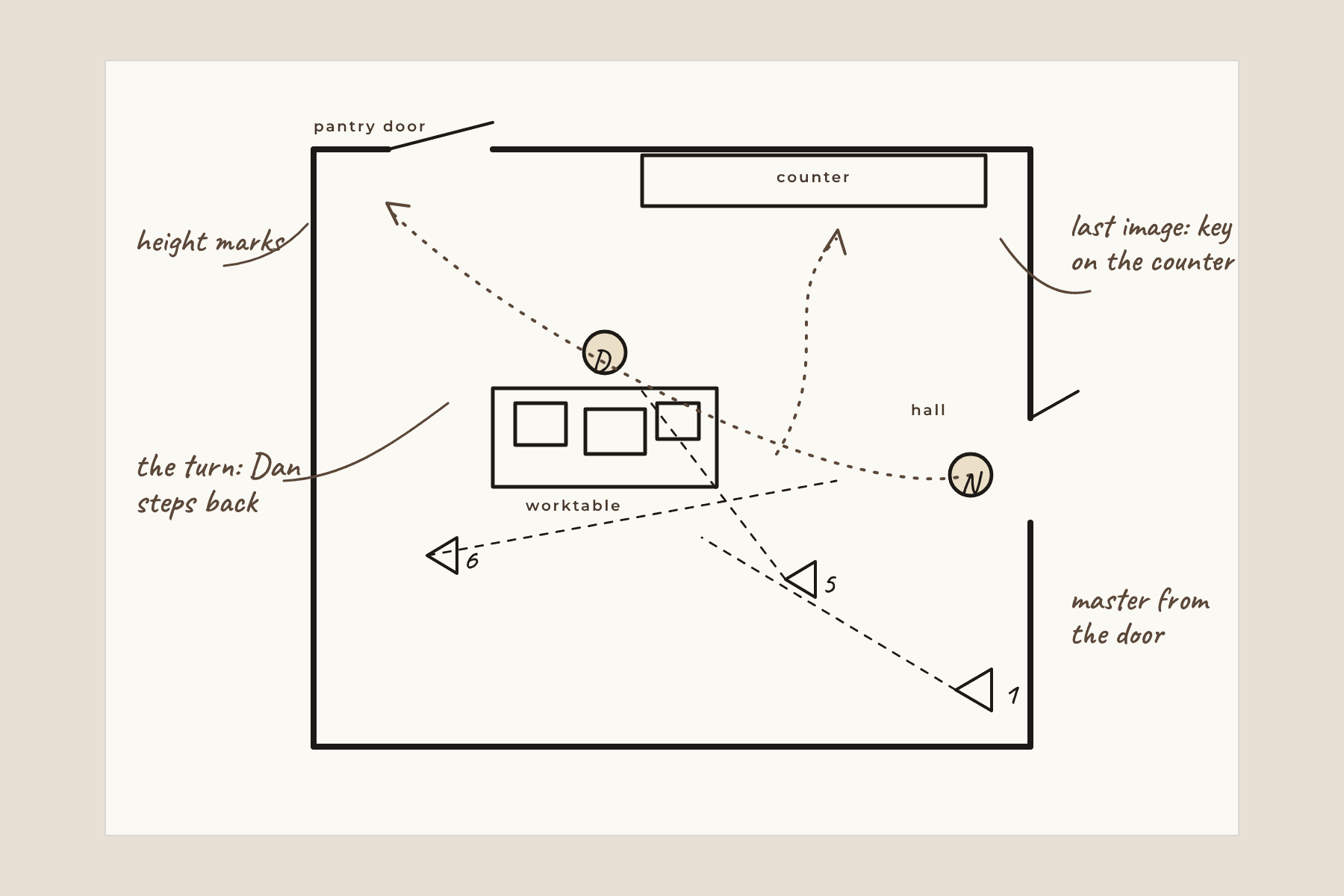
Here is the plan from above. Draw yours with a pencil and a ruler: you only need walls, doors, large furniture, and a line for each actor's path.
5. Build the shot list from the blocking
Go beat by beat. For each, ask which image from step 3 the beat owns, and what the cheapest shot is that delivers it. Then give every shot a priority.
Worked example · shot list for scene 14 (hypothetical)
| # | Shot | Beats | Serves | Priority |
|---|---|---|---|---|
| 1 | Wide master from the hallway end, showing the worktable, the counter and the pantry door | A to E | The distance across the room, and the whole scene as a safety | Must |
| 2 | Insert of the height marks on the pantry door, from Nora's view | B | The height marks | Must |
| 3 | Medium single of Nora | A to C | Her objective, in her own frame | Nice |
| 4 | Medium single of Dan | A to C | His resistance | Nice |
| 5 | Close-up of Dan | D | His face at the turn | Must |
| 6 | Close-up of Nora | E | The request | Must |
| 7 | Insert of the key set down on the counter | E | The last image | Must |
If time runs short: drop shots 3 and 4 first and cover beats A to C from the master, which already exists. Never drop 5, 6 or 7.
On the sample call sheet from the other guide, this scene is given the time between 08:30 and 11:30. That is an invented schedule, but it shows the shape of the problem: seven shots, several of them close, in a fixed window that others have planned around. The ranking exists so that the decision about what to lose is made at your desk and not in the middle of the day.
6. Check the plan with the people it affects
A plan only you have seen is half a plan. ScreenSkills, writing about UK film and TV drama, describes the director as developing the filming style with the director of photography. It describes the 1st assistant director as the person who breaks down the script, schedules and manages the set so the director can concentrate on the actors and framing. It describes the script supervisor as the person who prepares continuity breakdowns and keeps the records. Titles and who does what vary by production, and on a small shoot one person may cover several of these, but the questions are the same.
- With your DP or camera operator: Does the master work from that position? Which shots can share a setup? Is there a cheaper way to get the same image?
- With your 1st AD, or whoever builds the schedule: Do the shots fit the time you have? What is the priority order?
- With whoever keeps continuity: What changes in the scene? In the sample, Dan's jacket stays on, a key on a ribbon is handled, and tape is partway through a box.
- With the actors: The point of the scene and the blocking, in your own words.
The one-page prep pack
Put the scene on one page, for you and anyone who asks. If it doesn't fit, you probably haven't finished deciding.
Step 1: Write the point and the turn
Two sentences, plus the exact line or moment where the scene turns.
Step 2: Attach the beat map
A short table: beat, lines, what changes, who drives.
Step 3: Add the must-see images
Three or four, in plain words.
Step 4: Draw the floor plan with each actor's path
Label the paths by beat letter. Mark the doors and the largest furniture.
Step 5: List the shots with priorities and the cut order
Must or nice, and the sentence that begins "If time runs short".
Step 6: Note props, continuity and questions
The things the others need to know or decide: the key on a ribbon, a jacket, the half-taped box, and your questions for the DP and the AD.
Try it: prep a second scene
Here is a second scene from the same invented film. Prep it on one page using the six steps above. It was written for this exercise and differs from the hallway scene on the sample call sheet in the other guide, so treat the two as separate drafts.
Dan
Nora
Dan
Nora
Dan
Practice exercise
Prep the hallway scene
- Task
- Write the point and the turn, a three-beat map, the must-see images, a simple floor plan, and a shot list with priorities and a cut order.
- Time
- About 30 minutes.
- Write two sentences for the point and name the turn.
- Mark the beats. This scene has three or four.
- List no more than three images the audience must see.
- Draw the hallway from above and mark each actor's path.
- List the shots and mark each must or nice. Write your "If time runs short" line.
Compare your answer. One reasonable reading: the scene is about Dan letting Nora keep the thing she fought for while still leaving, and the turn is "Keep it." The must-see images are the jacket on the hook, the key passing from her hand to his closing her fingers around it, and the door closing. A cheap plan could be one wide from the kitchen doorway, one insert of the hands and key, and one close-up of Nora as the door shuts. Yours may differ and still be right, so long as every shot serves a beat.
OutcomeA one-page plan for a short scene that you could hand to a DP or an AD without explaining it aloud.
Where to go next
If you also work with actors, the same scene read from the performer's side is in how to break down a scene. To see how a scene like this lands on a shoot-day schedule, the sample sheet in anatomy of a film call sheet shows the times and notes that the AD and the production put around your plan.
the vitoniou letter
New guides for filmmakers, sent sparingly.
Occasional emails when we publish a new guide, a free tool or an industry note worth your time. Unsubscribe anytime.
Questions
How long should I spend prepping one scene?
It varies with the scene, your experience and the time the production gives you, so no single number is right. A better test is whether you can state the point, the turn and your must-have shots without looking at your notes. When you can, the prep for that scene is doing its job.
Do I need a storyboard as well?
Not for a dialogue scene like the sample. A floor plan and a ranked shot list answer most of the questions. Rough sketches help when a shot is hard to describe in words, such as an unusual angle or a movement. Draw only those.
Should I show the shot list to the actors?
Directors differ on this. Our view is that actors benefit most from the intent of the scene and the blocking, because those shape their choices. The shot list is mainly for you and the camera team, and sharing it is optional.
Written by
The people who design Vitoniou's journals and workbooks for actors and film creatives. We write these guides to teach the methods our printables are built around, and we update them when we improve them.
Sources
- ScreenSkills. Director (Film and TV Drama). ScreenSkills. Describes the director as holding the creative vision from pre-production to the final edit, developing the filming style with the director of photography and blocking actors' positions and moves. UK-focused and undated. Opened 2026-10-01; not re-opened for this article.
- ScreenSkills. Assistant director. ScreenSkills. Describes the 1st AD as breaking down the script, scheduling and managing the set so the director can focus on actors and framing. UK drama framing. Opened 2026-10-01; not re-opened for this article.
- ScreenSkills. Script supervisor (Film and TV Drama). ScreenSkills. Describes continuity breakdowns, timing the script and keeping records. UK drama framing. Opened 2026-10-01; not re-opened for this article.
- National Film and Television School. Director Prep Lab. NFTS. A course page. It lists floor plans and shot lists among the parts of director prep. Marketing page, so used only for what prep training covers. Opened 2026-10-01; not re-opened for this article.
- Directors Guild of America. The Director's Prep: Blocking & Shot Listing. DGA, 2019. An event summary for a lab on blocking and shot listing a scene before shooting. No detailed method, so used only to show that these are standard prep topics. Opened 2026-10-01; not re-opened for this article.
Read next
Scene studyGuide
How to break down a scene, step by step
A simple, repeatable way for actors to break down any scene (objectives, obstacles, stakes, and beats) so you walk in specific instead of vague.
On setGuide
Anatomy of a film call sheet: every field and why it's there
What is on a film call sheet? An annotated sample, a field-by-field table of what each part tells you, and a night-before check for actors and new crew.
CareerGuide
How to organize your acting career
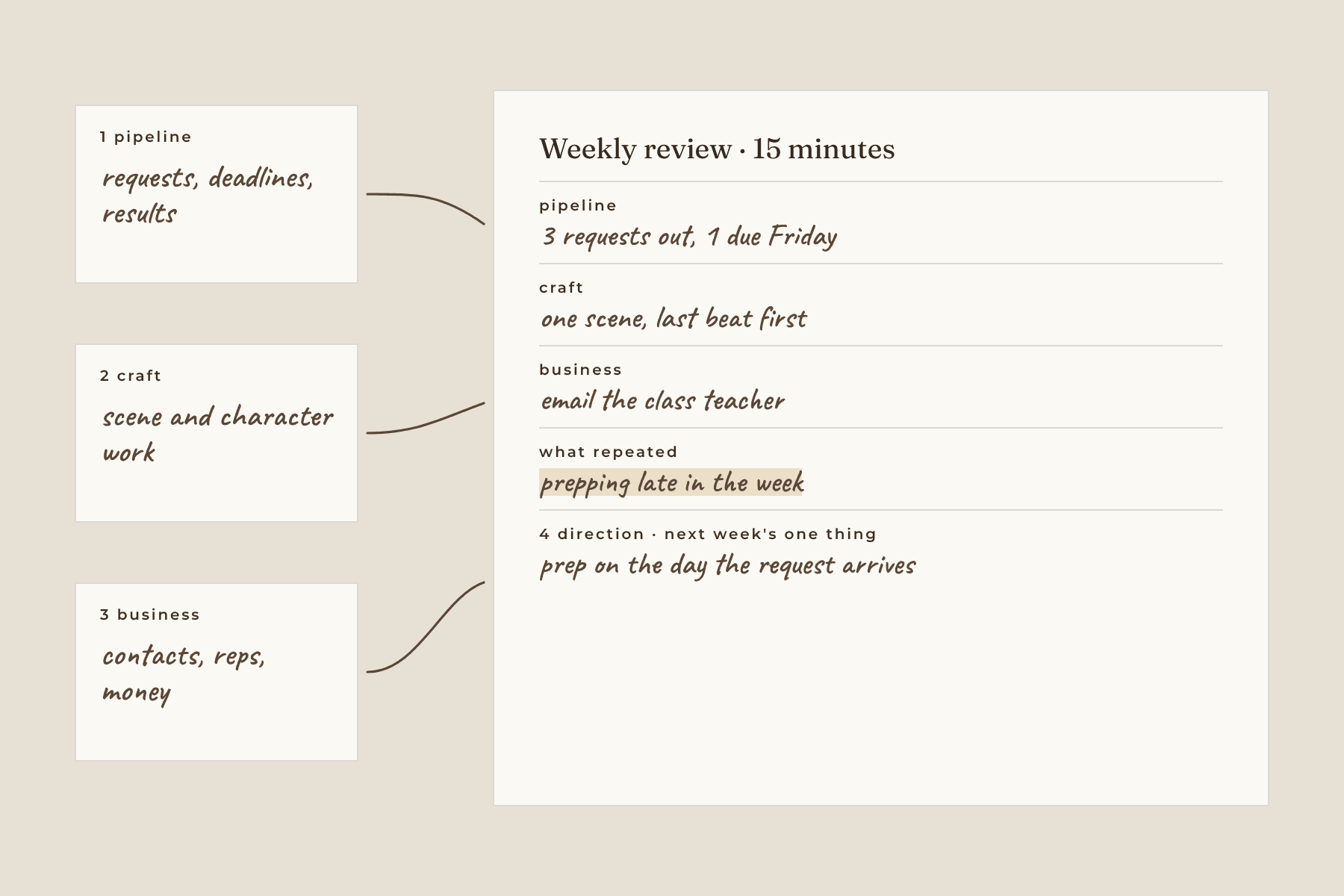
How to organize your acting career: sort what you track into four parts (pipeline, craft, business, direction) and run a 15-minute weekly review that sets next week's one thing.