On setGuide
Anatomy of a film call sheet: every field and why it's there
An annotated sample sheet for a fictional short, a field-by-field reference for actors and new crew, and a two-minute check to run the night before your call.
A call sheet is the one-page plan for a single shoot day. It tells you when and where to arrive, which scenes are being filmed, who is needed and when, what the weather and daylight are doing, and who to call. Read it in this order: your time, your place, your scenes, your contacts, then the version number. This guide walks through a sample sheet field by field, so that your first real one is no surprise.
What a call sheet is, and who makes it
A call sheet is a daily production document. It's built from the shooting schedule and sent to the cast and crew before the shoot day. Each person needs a different part of it, which is why it carries so many fields.
Who writes it depends on the production. A US-focused practitioner article describes the second assistant director (2nd AD) as the person who drafts the call sheet and handles the paperwork around it. ScreenSkills, writing about UK film and TV drama, lists call sheets among the documents a production coordinator distributes from the production office. A film school's student handbook says the AD supervises the call sheet. These aren't contradictory: one person may draft, another may approve and a third may send. On a small independent shoot, one person may do all three.
What this means for you as a reader: the sheet comes from the production, and the production is the place to ask when something is unclear. Whoever is named as the contact is the right first call.
A sample call sheet, annotated
Below is a sample sheet for a short film. This is a Vitoniou teaching example: the film, the people, the addresses, the phone numbers, the times and the weather are all invented for this guide, and real sheets are laid out differently. The film is "The Key", the short whose kitchen scene we use in how to break down a scene. The header block comes first.
Sample call sheet · header block (hypothetical)
THE KEY · Shoot day 2 of 3 · Saturday 14 March · Version 2, issued Friday 13 March, 18:40 (replaces version 1)
| Field | Sample entry |
|---|---|
| General crew call | 07:30 |
| Estimated lunch / wrap | About 13:00 / about 18:00 |
| Sunrise / sunset | 06:12 / 18:04 |
| Weather (forecast) | Overcast, 11°C. Light rain possible after 15:00 |
| Base and parking | 12 Alder Row. Parking in the rear lot, entrance from Mill Lane. Please don't park on Alder Row |
| Nearest hospital | Example General Hospital, Harbour Road. About 10 minutes by car |
| Safety briefing | 08:15 at the kitchen door, everyone |
| Director / 1st AD | Sam Okafor / Lena Hart |
| Running late or lost | 2nd AD Ravi Menon, 07700 900123 |
Next come the two tables that most readers care about: the schedule for the day and the cast.
Sample call sheet · schedule and cast (hypothetical)
Schedule
| Time | Sc | Set and description | D/N | Cast | Pages |
|---|---|---|---|---|---|
| 08:30 | 14 | INT. KITCHEN, the family house. Nora and Dan argue over the key | N | 1, 2 | 2 3/8 |
| 11:30 | 15 | INT. HALLWAY. Dan leaves the house | N | 2 | 3/8 |
| 13:00 | Lunch (estimated) | ||||
| 14:00 | 17 | EXT. BACK GARDEN. The estate agent waits at the gate | D | 1, 3 | 1 1/8 |
| Weather cover: Sc 18, INT. PANTRY, Nora alone | N | 1 | 1/2 |
Cast
| # | Character (actor) | Pickup | Call at base | Makeup and wardrobe | On set |
|---|---|---|---|---|---|
| 1 | Nora (Priya Raman) | 06:45 from home | 07:30 | 07:40 | 08:30 |
| 2 | Dan (Tom Whitaker) | 07:00 from home | 07:30 | 08:00 | 08:30 |
| 3 | Estate agent (Joy Mensah) | Own travel | 13:00 | 13:15 | 14:00 |
Notes
- Wardrobe: Nora wears the blue coat from day 1. Dan's jacket stays on in Sc 14 and comes off in Sc 15.
- Props: the key on the blue ribbon is with props. Don't take it home.
- Sound: quiet please between takes, the neighbours are close.
- Advance (subject to change): day 3, Sunday 15 March, general call 08:00, Sc 19 to 21.
The notes on that sample are made-up, but each kind of line is common: costume continuity, a prop with a rule attached, a courtesy note and a heads-up for tomorrow. Wording varies by production.
Field by field: what each part is for
The table below covers the fields in the sample, plus a few you will see elsewhere. It says what each one tells you and what to do with it. Names differ from sheet to sheet, so "General crew call" may read "Crew call" or "Unit call" on yours.
| Field | What it tells you | Who leans on it most | What you should do |
|---|---|---|---|
| Title, shoot day number | Which production, and how far through the shoot you are (day 2 of 3) | Everyone | Check you have the right production |
| Date and day | The shoot day this sheet covers | Everyone | Compare with your own diary entry |
| Version and issue time | Whether this is the newest sheet | Everyone | Note it. When a new version arrives, throw the old one away |
| General crew call | The time most of the crew are expected at the base | Crew | Cast usually have their own time. Don't use this one unless the sheet says to |
| Pickup (if offered) | When a driver collects you from the address you gave | Cast | Be ready at the door, with your phone on, before this time |
| Call at base | When you are expected to arrive and check in | Cast and crew | This is your arrival time. Plan to be there before it, not at it |
| Makeup and wardrobe | When you are due in those departments | Cast | Allow for the check-in before it |
| On set | When you are expected to be ready in costume for the scene | Cast | Don't read this as the time the camera rolls. Shooting can start later or earlier |
| Sunrise and sunset | How much daylight the day has | Camera, lighting, directing, AD | Read it for context. If your scene is outside, daylight shapes the order |
| Weather | The forecast for the day | Everyone, outdoors especially | Dress for it and look for a weather cover scene |
| Base and parking | Where to go, and where not to park | Everyone arriving by car | Check it the night before, and follow the parking instruction |
| Nearest hospital | Where the nearest emergency care is | The production | Know that it's there. See "A note on safety fields" below |
| Schedule | Order of scenes, set, day or night, cast and page count | Everyone | Find your scene numbers and what shoots before them |
| Scene number and cast numbers | Which scenes you are in, via the cast list | Cast | Match the scene numbers to your script, as in how to break down a scene |
| D/N | Whether the scene is day or night in the story | Costume, makeup, camera, lighting | Compare it with your continuity: what you wore, how you look |
| Pages | How much script the scene covers. The sample counts in eighths of a page, and productions may count differently | AD, director | Use it as a rough sense of how long you will be on that scene |
| Weather cover | A fallback scene if the weather turns | AD, department heads | If rain starts, expect the plan to change. Look for a revised sheet |
| Department notes | Costume, props, sound, art and others | The named department | Read the ones with your character's name or items you handle |
| Contacts | The people to call, and the number for lateness | Everyone | Save it in your phone before the day |
| Safety briefing | When everyone is asked to gather | Everyone | Be there on time. The production runs it for everyone |
| Advance schedule | A first look at the next day | Everyone | Use it for planning only. It may change |
A note on safety fields
Some call sheets carry details such as the nearest hospital, safety announcements, or notes about particular activities on set. One film school's student handbook requires the nearest hospital on every call sheet for its student shoots. That's a school's rule, and other productions set their own.
For the reader, there are two practical points. First, these fields exist because the production is responsible for a day's safety planning, not you. The people named on the sheet run that process. Second, if a note affects you and you don't understand it, ask the 2nd AD or the person named as your contact before the day, not on set. This guide doesn't explain how to plan for any hazard, and it shouldn't be used as a safety document.
Reading your own row: the two-minute check
Do this the night before, with the newest version open.
Step 1: Confirm the version
Look at the version number and issue time. If you also have an older copy saved, delete it so you can't open it by mistake.
Step 2: Find your row and mark three times
Your pickup (if there is one), your call at base and your on-set time. Write the first two in your phone's calendar with an alarm. The on-set time is for your preparation.
Step 3: Check your scenes against your script
Find the scene numbers on the schedule, open your script to each one, and read your lines for those scenes again. Read the scene before yours as well, so you know where the story has just been. The scene breakdown method is a quick way to prepare.
Step 4: Read the notes with your name or character's name on them
Wardrobe, props, hair and makeup, and any special note. Look for anything you are asked to bring, do or avoid.
Step 5: Save the late contact and check the base
Put the number for running late in your phone. Look up the base address and the parking instruction once, and note how long your journey takes.
That is it. The weather, the daylight and the advance schedule are worth a glance, but the five steps above are what keep you on time.
Try it: ask the sample sheet six questions
Practice exercise
Read the sample sheet
- Task
- Answer these six questions from the sample sheet above, then check the answers below.
- Time
- About 5 minutes.
- When must Priya Raman be at base, and what is the earlier time on her row?
- When is Tom Whitaker due in makeup and wardrobe?
- Which scene is Joy Mensah in, and when must she be on set?
- Whom do you contact if you are running late on the morning of the shoot?
- You saved version 1 on Thursday. Which one applies to the shoot on Saturday?
- What is the general call on day 3, and how much should you rely on it?
Answers. (1) 07:30 at base. The earlier time, 06:45, is her pickup from home. (2) 08:00. (3) Scene 17, in the back garden, on set at 14:00. (4) The 2nd AD, Ravi Menon, on the number in the header. (5) Version 2, the newest one. (6) 08:00, but treat it as advance information that may change.
OutcomeYou can find a call time, a scene, a contact and the current version on any sheet in under a minute.
Where to go next
Preparing for the scenes on your sheet is the next job, and how to break down a scene gives you a method you can finish in a few minutes. If you are an actor building a routine around bookings, how to organize your acting career shows where a shoot day fits in a weekly review.
the vitoniou letter
New guides for filmmakers, sent sparingly.
Occasional emails when we publish a new guide, a free tool or an industry note worth your time. Unsubscribe anytime.
Questions
What if I haven't received a call sheet the evening before?
Ask the production contact named in your booking, or your agent if you have one. When sheets go out varies by production, so don't wait in silence and don't guess from an earlier sheet.
What do I do if the call sheet changes the night before?
Treat the newest version as the one that counts, check its version number and issue time, and look at your own row again. If the change affects you and the sheet doesn't say how to confirm, ask the person who sent it. Don't assume the old time still stands.
Do actors need to understand the whole sheet, or just their own row?
Your own row comes first. The rest tells you what is happening around you: which scenes come before yours, where the day might slip, who to ask, and what the weather is expected to do. Two minutes with the full sheet saves a lot of questions on the day.
Written by
The people who design Vitoniou's journals and workbooks for actors and film creatives. We write these guides to teach the methods our printables are built around, and we update them when we improve them.
Sources
- ScreenSkills. Production coordinator (also known as production office coordinator (POC)). ScreenSkills. Lists distributing schedules, crew lists, script revisions, progress reports and call sheets among the production coordinator's duties. UK-focused and undated. Opened 2026-10-01; not re-opened for this article.
- Brandon Riley. What does a 2nd AD do besides make a call sheet?. AssistantDirecting.com, 2019. A practitioner newsletter, US-focused and compiled from DGA descriptions, describing the 2nd AD's role in producing the call sheet and the paperwork around it. Not an official source. Opened 2026-10-01; not re-opened for this article.
- LMU School of Film and Television. The Assistant Director. LMU School of Film and Television, Student Production Handbook, 2021. A student production handbook. It says the AD supervises the call sheet and requires the nearest hospital on every call sheet for student shoots. That is a school rule, not an industry law. Opened 2026-10-01; not re-opened for this article.
Read next
Scene studyGuide
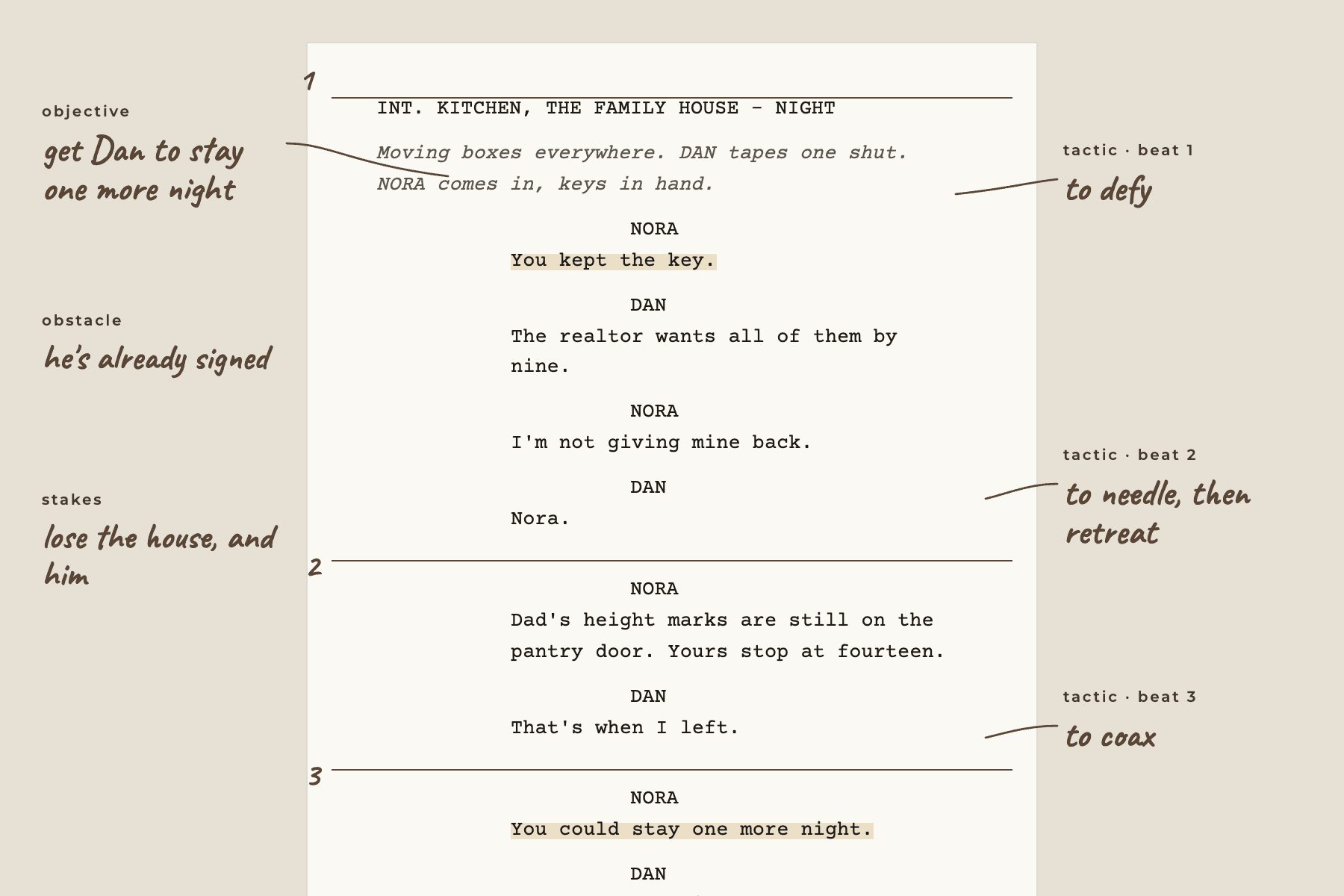
How to break down a scene, step by step
A simple, repeatable way for actors to break down any scene (objectives, obstacles, stakes, and beats) so you walk in specific instead of vague.
CareerGuide
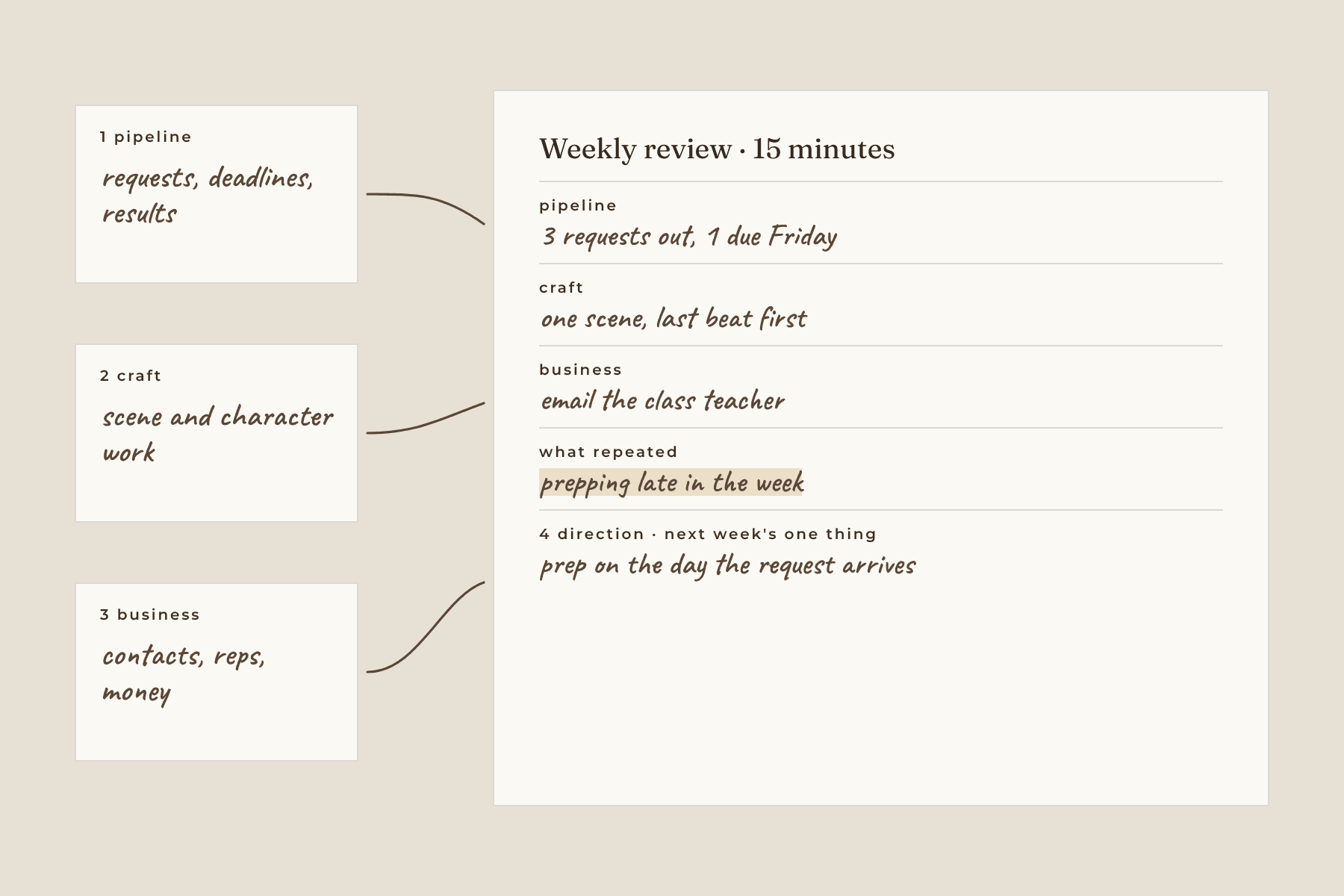
How to organize your acting career
How to organize your acting career: sort what you track into four parts (pipeline, craft, business, direction) and run a 15-minute weekly review that sets next week's one thing.
AuditionsGuide
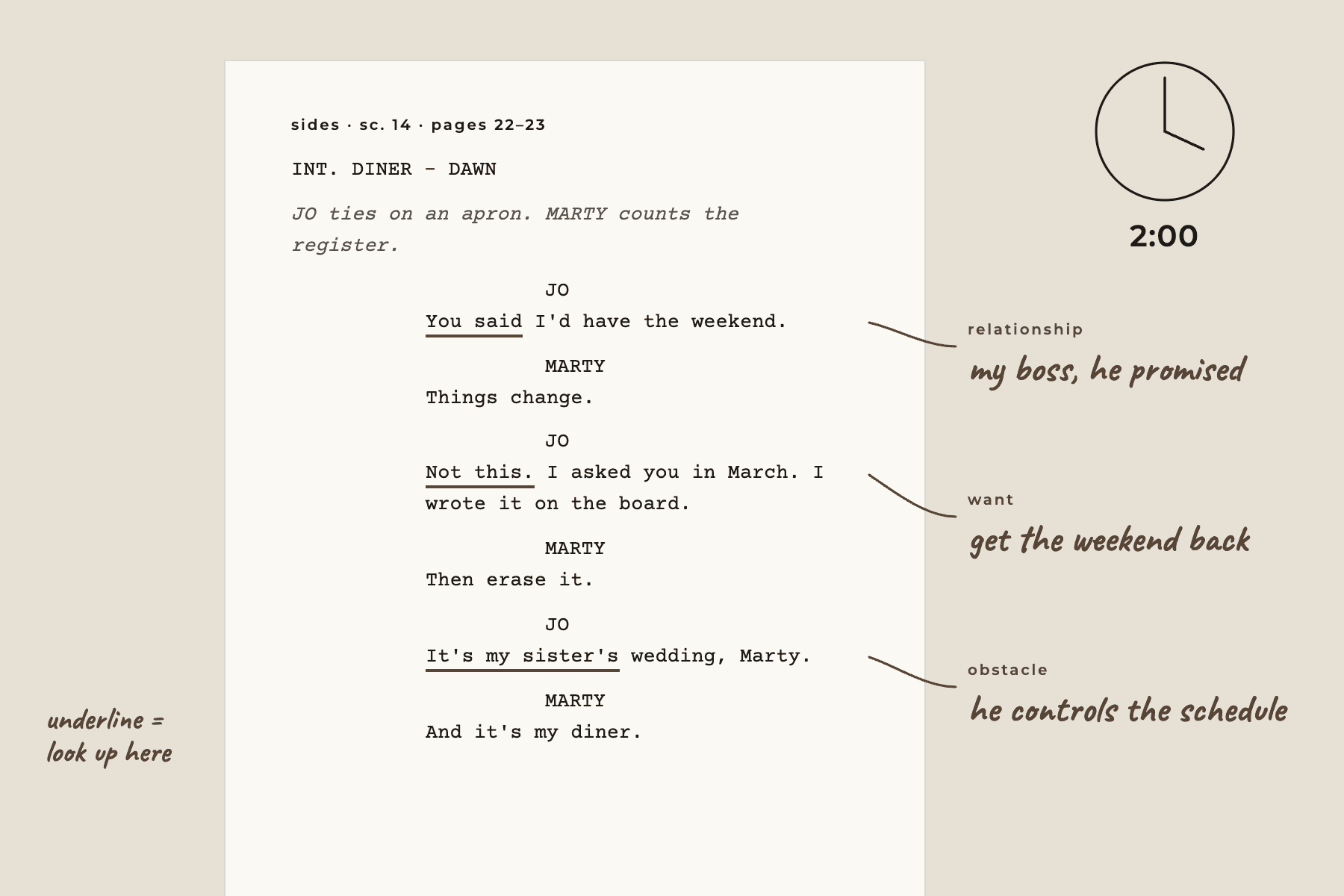
Cold reading tips that actually work
Practical cold reading tips for actors: how to make fast, specific choices, use the sides, and stay present when you get the scene minutes before the audition.