Shots and compositionExplainer
Shot sizes and what each does to a scene
One invented scene drawn at eight sizes, three questions for choosing one, and why the names never quite match.
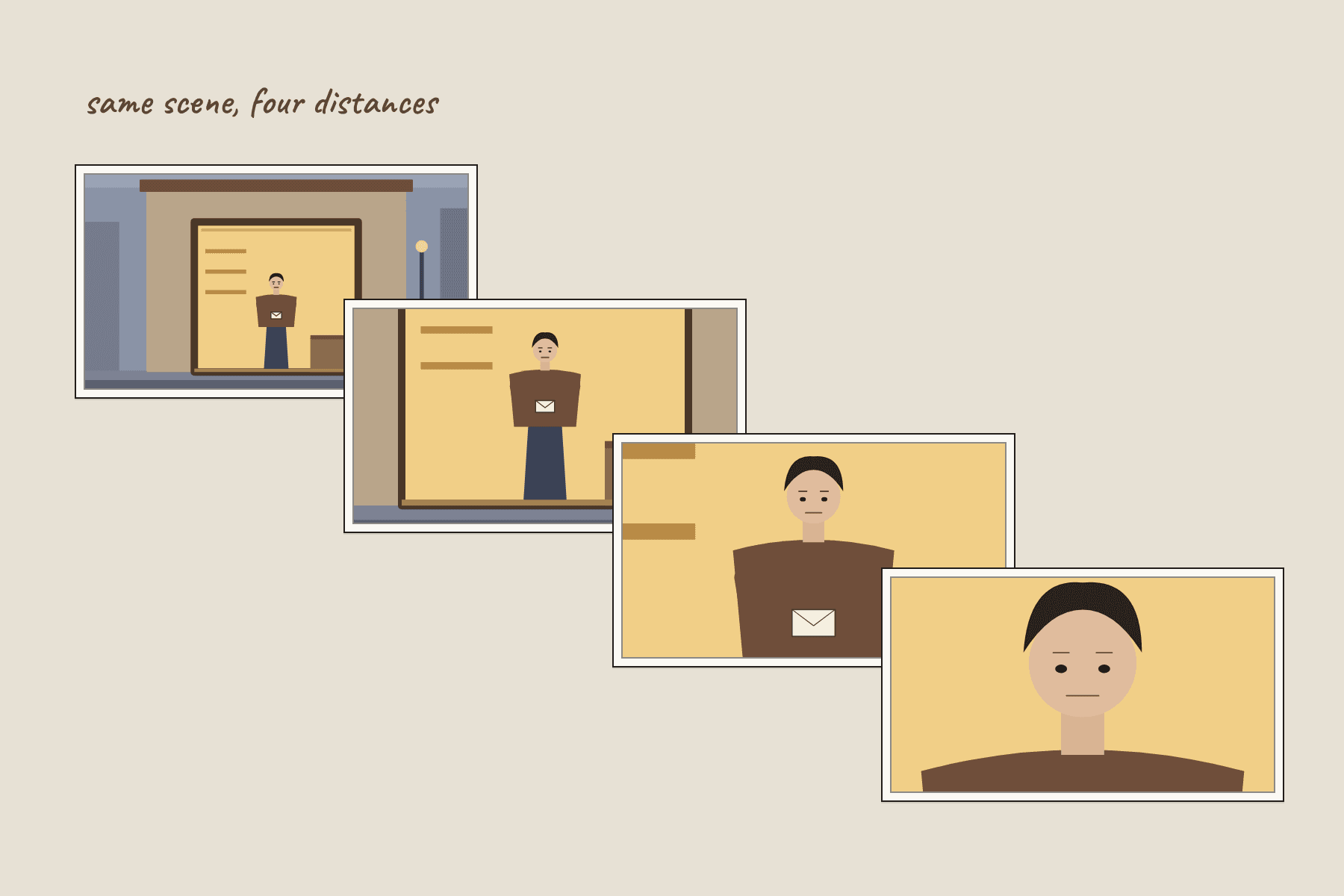
A shot size is how much of the world, and of a person, the frame includes. The wider the frame, the more the audience learns about the place and the less they learn about the person. The tighter the frame, the reverse. Everything else in this guide follows from that trade.
Below, one invented scene is shown at eight sizes, so the only thing that changes from picture to picture is how much of the frame is used.
The scene we'll use
The scene is a teaching example, invented for this guide and not based on any film. We'll call it "Closing Time". Dana runs a small bakery. The shop is closed and the lights are on. She stands in the lit shop holding an unopened envelope from her brother, who wants to buy her out. She hasn't decided whether to read it.
The drawings below are one master picture, cropped. That's a useful way to see size, but it isn't how a camera works. On a real set a size comes from where the camera stands and which lens it uses, and both change how the frame looks, not only how big things are. A later guide will take lenses on their own.
Eight sizes, one scene
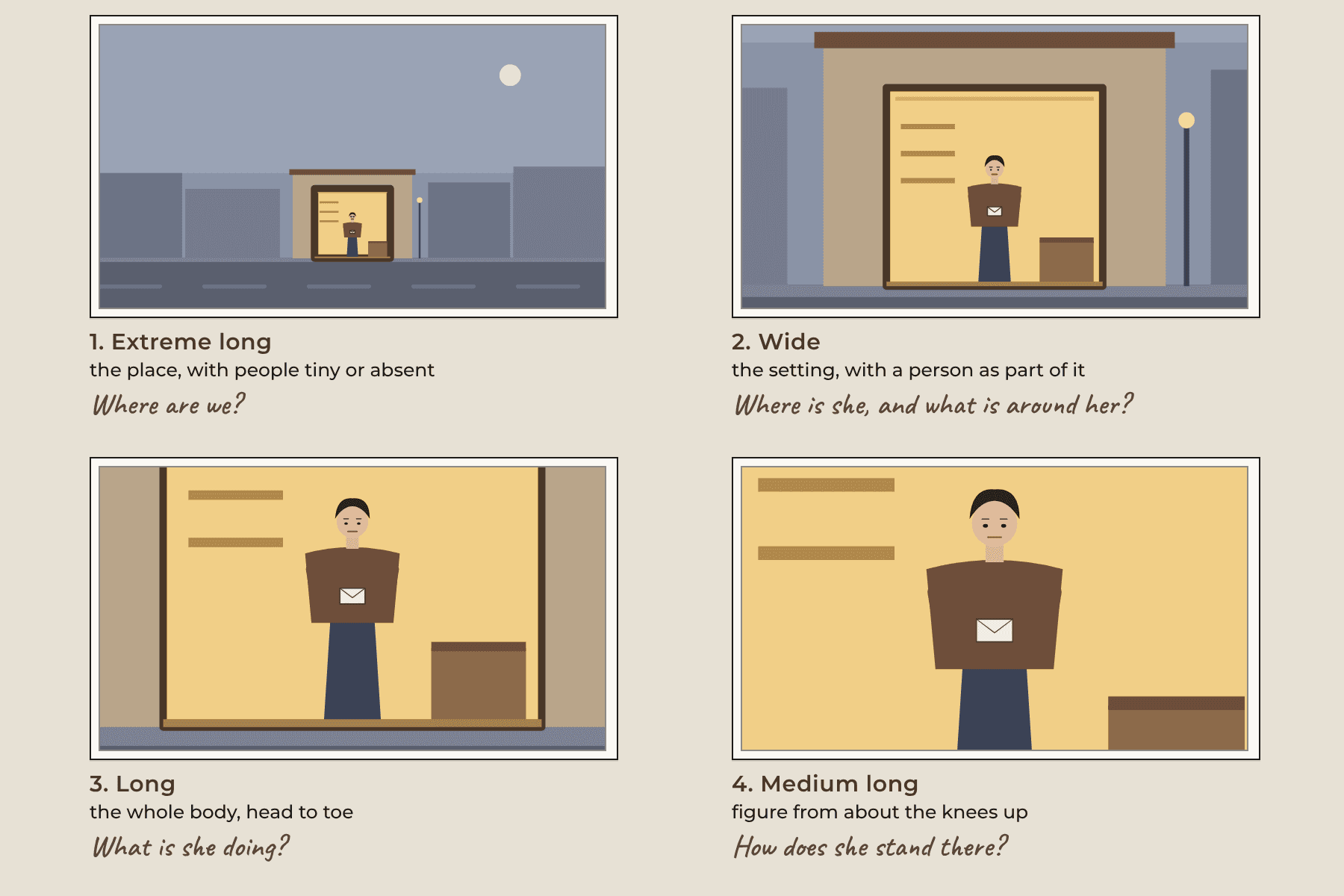
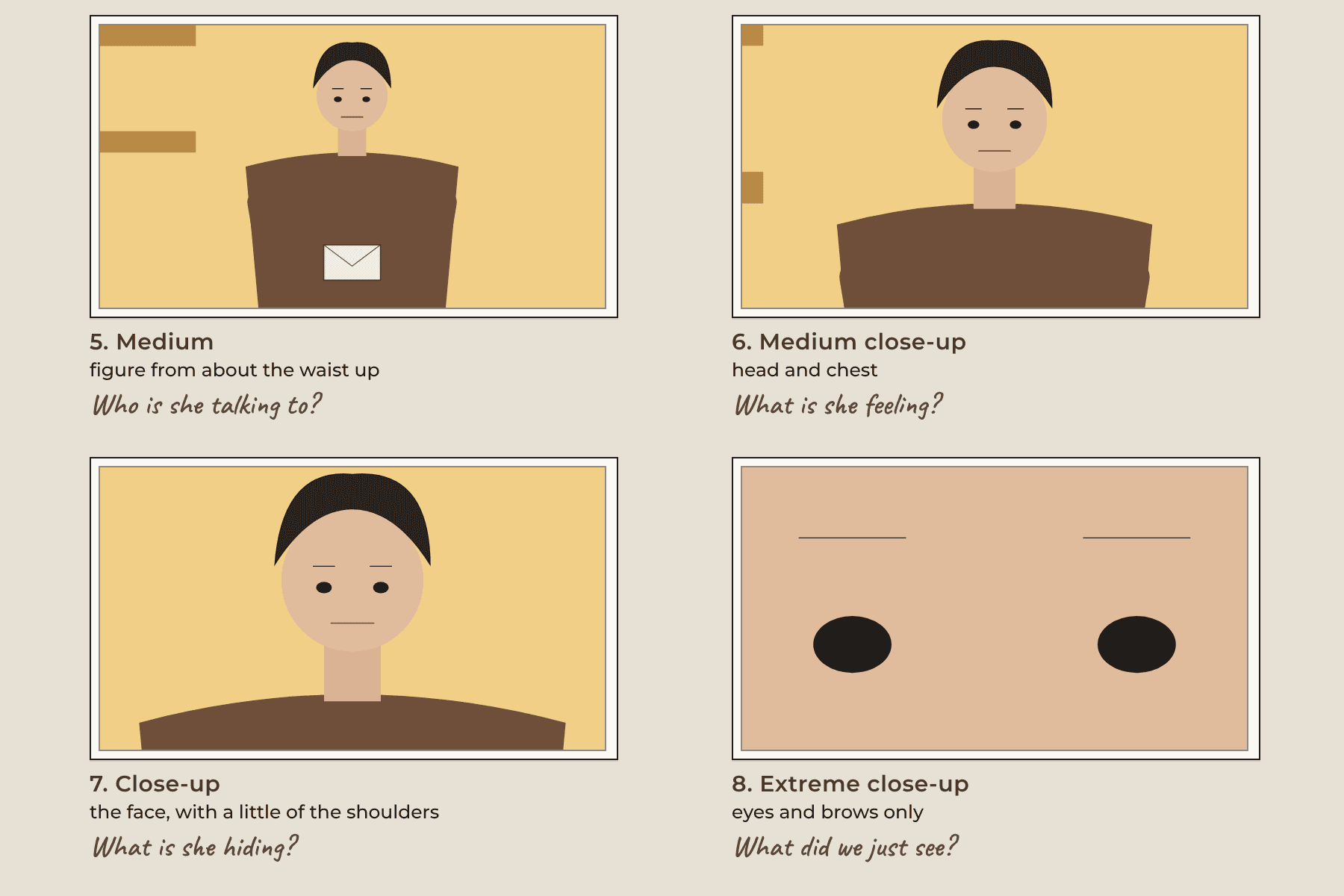
Here is what each size does in this scene. These are teaching examples, not rules.
| Size | What the frame holds | What it does in "Closing Time" |
|---|---|---|
| Extreme long | The street, the shop as a small lit box | Says where we are and how small the shop is. Dana is nearly absent. |
| Wide | The shopfront and her place in it | Shows her alone in a lit room at night. |
| Long | Her whole body | Shows what she is doing: standing very still with the envelope. |
| Medium long | About knees up | Her posture and hands become readable. |
| Medium | About waist up | The envelope and her face share the frame. Good for dialogue. |
| Medium close-up | Head and chest | Her face leads and the envelope has left the frame. |
| Close-up | The face | We watch her decide. |
| Extreme close-up | Eyes and brows | One detail, held for a beat. Use sparingly. |
What the sources say about each end of the range
The definitions below come from two sources, and they agree more than they differ.
At the wide end, Yale's guide describes an extreme long shot as one where the object shown is very small, so a building, landscape or crowd fills the screen. It adds that these are usually the first or last shots of a sequence and can work as establishing shots. Barrance makes a similar point and adds that people in an extreme long shot can look lost, lonely or insignificant.
In the middle, Yale describes a long shot as one where a standing figure is nearly the height of the screen. It calls the shot relatively stable, able to take movement without reframing, which is why it suits full-body action. Barrance says long shots are good for showing people together and for showing action, and notes that mid shots are easier to use than close-ups for moving subjects but have less impact.
At the tight end, Yale's close-up is a frame where a person's head, or an object of similar size, fills the frame. Its extreme close-up is a small object or part of the body. Barrance says close-ups let us see expressions and emotions, and that moving closer builds intensity.
Names change, the idea doesn't
The two sources also name the same territory differently. Yale calls one scale "medium long shot" and notes it is also called plan américain. Barrance says medium long shots are sometimes called three-quarter shots, and he describes a mid shot as running from the hips up. In this guide, "medium long" means about knees up, which is our reading rather than Yale's wording. Yale has no entry for a medium shot or a wide shot at all.
Yale makes the underlying point directly: framing scales are not universal, but established in relationship with other frames from the same film. This varies by production, by country and by the person writing the shot list. Treat the names as shared shorthand, not as measurements. If it matters, say where the frame line falls.
Moving closer is not the same as zooming in
The drawings above are crops of one picture, so the camera never moves. On a real set that is a trap. Barrance advises that when you change shot size you should usually move the camera to a different position around the subject, to make the edit less obvious. If one shot is from directly in front, the next should be from an angle or the side. If you don't, you can get a jump cut, where the camera seems to jump forwards or backwards.
In practice, that means a cut from our medium shot to our close-up of Dana, both square on, would feel like a glitch. Shift the second camera a few steps to one side, and the cut reads as a new view of her. Barrance is a teacher of film with more than thirty years of teaching behind him, so treat this as a classroom rule of thumb. Some productions break it on purpose.
Choose a size with three questions
Every size is a trade between place and person. Three questions make the trade visible.
- What must the audience see? If the answer is a place, an action or two people together, go wider. If it's an expression or a small object, go tighter. In Barrance's words, an insert is a close-up that shows something important viewers might miss, such as what a character is holding or reading.
- What should the scene feel like? Distance reads as calm, exposure or loneliness. Closeness reads as pressure or intimacy. Moving closer across a scene can build intensity, as Barrance suggests. Staying wide on a moment that would normally get a close-up is a choice too.
- What did the shot before it show? A close-up lands harder after a wide shot than after another close-up. Sizes work in relation to each other, which is Yale's point about scale again.
Worked example · a six-shot list for Closing Time (hypothetical)
The scene has one turn: Dana decides to read the envelope. Here is a possible list, with the reason for each size.
| # | Size | Frame line | Why |
|---|---|---|---|
| 1 | Extreme long | Whole street, shop lit | Place and time. We learn she's alone. |
| 2 | Long | Dana head to toe in the shop | Her stillness. The envelope is a small dot of white. |
| 3 | Medium | Waist up, envelope in both hands | Face and envelope together, so we see what she's weighing. |
| 4 | Insert | Her thumb on the flap | The object, since viewers might miss it otherwise. |
| 5 | Close-up | Top of head to collarbone | The decision. We watch her face. |
| 6 | Medium long | Knees up as she sets the envelope down, unopened | Release. We step back to see what she chose. |
The list moves from place to person and back out again. It doesn't have to. You could open on the close-up and reveal the shop later, which Barrance notes is another way to work. The point is that each size is picked for a reason.
Practice exercise
Exercise · one doorway, six sizes
- Task
- Pick a doorway at home or school and film or photograph one person standing in it at six sizes.
- Time
- 20 minutes
- Ask a friend to stand in a doorway holding an object, such as a letter or a mug.
- Frame an extreme long, a long, a medium, a medium close-up, a close-up and an insert of the object. A phone is fine.
- After each one, write a frame line in six words or fewer ("waist up, mug visible").
- Lay the six frames in order. Write one sentence on what each one makes you look at.
- Pick the one you'd cut first, and say why.
OutcomeYou can see how a single moment changes as the frame tightens, and you have your own frame-line wording for a shot list.
Where to go next
Shot sizes are one decision on a shot list. For how sizes fit into the rest of prep, see a director's prep workflow, which ranks shots by what you can't lose. For actors reading a scene for what the camera will need, how to break down a scene is the companion.
the vitoniou letter
New guides for filmmakers, sent sparingly.
Occasional emails when we publish a new guide, a free tool or an industry note worth your time. Unsubscribe anytime.
Questions
What is the difference between a wide shot and a long shot?
It depends on who you ask. Yale's film analysis guide defines a long shot as one where a standing human figure is nearly the height of the screen. The filmmaking educator Tom Barrance describes wide shots as mainly showing the setting, and notes that some people say 'very long shot' for a wide shot where you can still see people. On a shot list, add a few words about what must be in the frame, so nobody has to guess.
How many shot sizes are there?
There's no fixed number. Yale's guide defines six scales (extreme long, long, medium long, medium close-up, close-up and extreme close-up). Barrance's guide adds mid shots, wide shots, a big close-up and inserts. This guide uses eight, because that's enough to show the whole range on one scene.
Written by
The people who design Vitoniou's journals and workbooks for actors and film creatives. We write these guides to teach the methods our printables are built around, and we update them when we improve them.
Sources
- Yale University Film and Media Studies. Film Analysis Guide: Cinematography. Yale University. Definitions of extreme long, long, medium long, medium close-up, close-up and extreme close-up shots, and the statement that framing scales are relative to other frames in the same film. Opened and read 2026-11-06.
- Tom Barrance. Shot Size in Filmmaking. Learn About Film. A filmmaking educator's guide: common names, what each size is used for, how moving closer builds intensity, and the insert. A single-author teaching site, used for common teaching usage. Opened and read 2026-11-06.
Read next
DirectingGuide
A director's prep workflow, from script to shot list
Prep one scene from script to shot list: find the turn, map the beats, block on a floor plan, rank your shots and check the plan with your team. Worked example.
Scene studyGuide
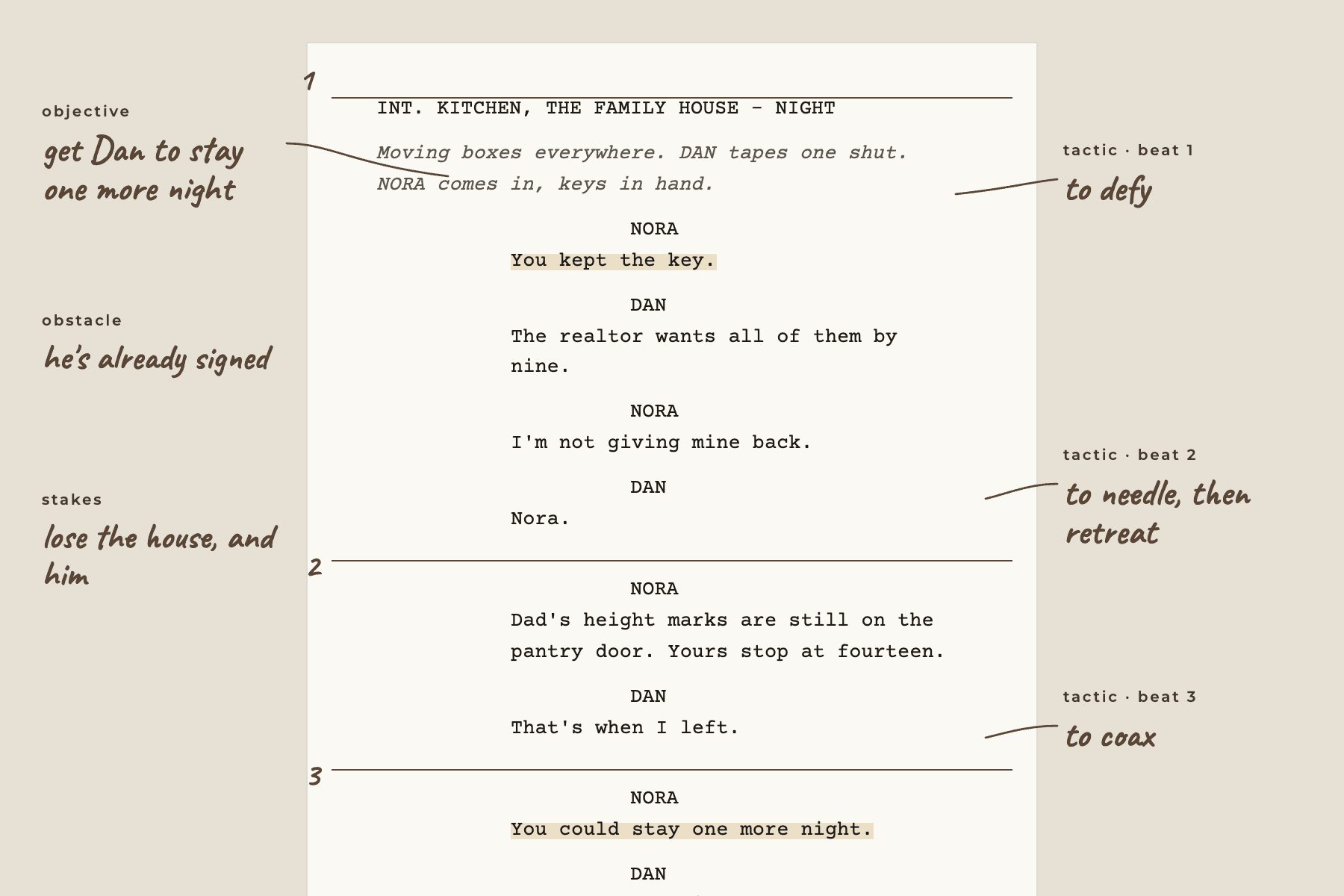
How to break down a scene, step by step
A simple, repeatable way for actors to break down any scene (objectives, obstacles, stakes, and beats) so you walk in specific instead of vague.