EditingWorkflow
The stages of an edit, from assembly to picture lock
One invented scene followed through every cut: who sees each version, which notes help at each stage, and why changes get more expensive the later they come.
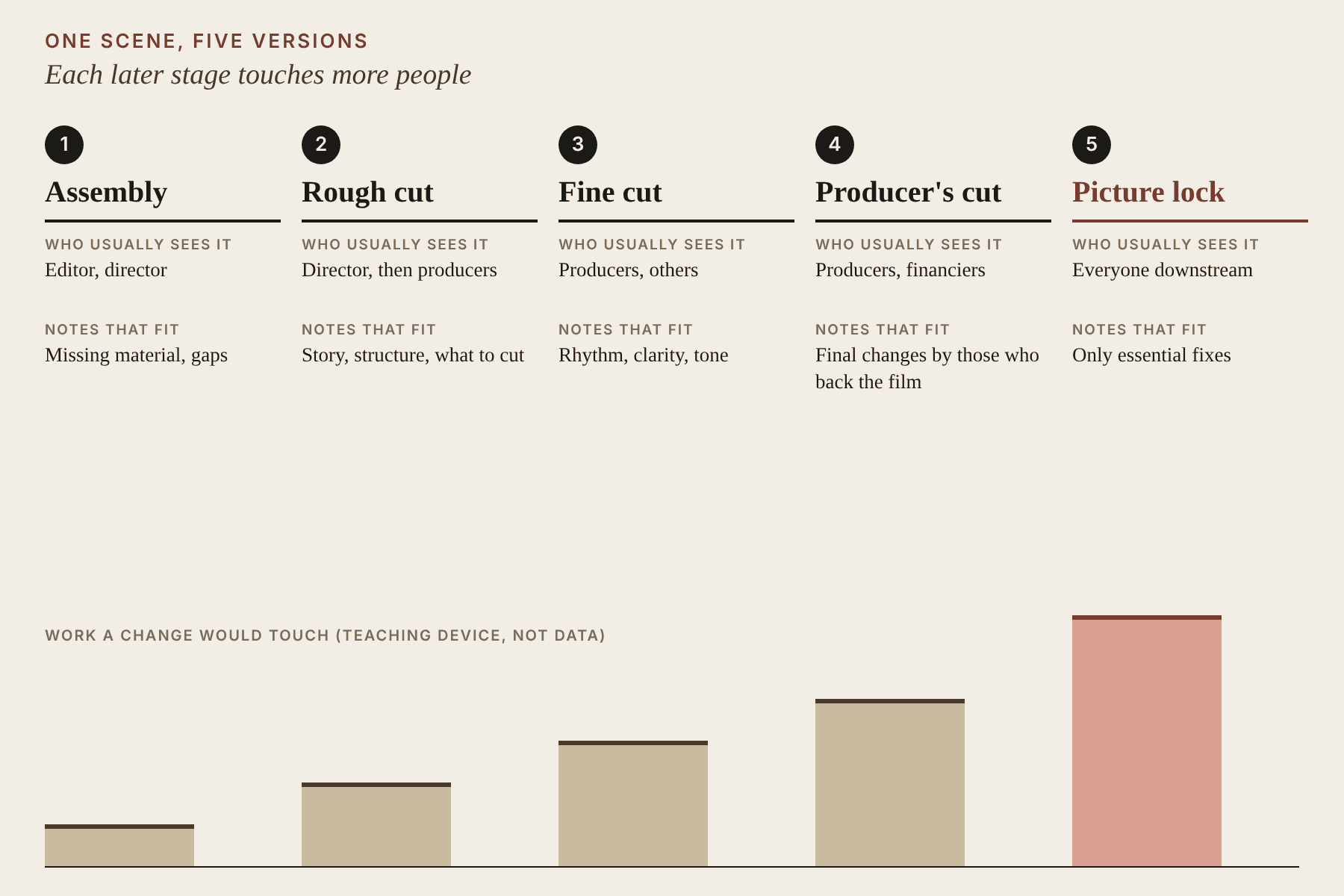
An edit moves through a short series of versions, and each one answers a different question. The assembly asks whether everything we shot is here. The rough cut asks whether the story works. The fine cut asks whether it plays well. Picture lock says the picture is finished, so everyone else can finish theirs.
Knowing which question a cut is asking tells you what kind of note helps right now, who is likely to see it, and why a change that takes minutes in week two can take hours in week twenty.
The sample film
"Seven Minutes" is a hypothetical short film invented for this guide. It isn't based on any film. We'll use one scene from it throughout.
In scene 12, Mara sits in a parked car outside a hospital with her brother Eli. She has to tell him she sold their mother's house. The page says it takes three minutes. The scene has one turn: Eli stops being angry and goes quiet.
All the timings, notes and numbers below are teaching examples, not data.
The stages at a glance
The stage descriptions in this table follow the Frame.io post-production workflow guide. The last two columns are Vitoniou's teaching framework, not a rule. Real productions combine, skip and rename stages.
| Stage | What it is | Who usually sees it | The question it asks | Notes that help |
|---|---|---|---|---|
| Assembly | Every scene cut together, following the script closely, from the previous day's dailies | Editor and director | Is everything here, and does it connect? | Missing coverage, scenes that don't join, anything to reshoot or pick up while the crew is still available |
| Rough cut | The assembly trimmed, or rebuilt, into a version that tells the story | Director and editor first, then producers | Does the story work? | Structure, what to cut, which scenes carry the story, whose performance to feature |
| Intermediate cuts | First, fine, director's and producer's cuts | Varies: test audiences, producers, financiers, the director | Does it play well, and does it satisfy the people backing it? | Rhythm, trims by seconds, clarity, tone |
| Picture lock | The edit is fixed | Everyone downstream | Is it final enough to finish? | Only essential fixes, and each one needs a plan |
Assembly: everything, in order
The assembly is the first full pass. According to Frame.io, the editor builds it from each day's footage, often just a day or two behind the shoot, and it follows the script closely, with every line and action shot. It has no effects or color correction, no sound effects and usually no temporary music. It can run more than twice the length of the final film.
That length is expected. The assembly is a map of what exists, not a version anyone is proud of.
In "Seven Minutes", the assembly of scene 12 runs six minutes against three on the page. Every take of every line is in it, so Eli says "You sold it?" three times in a row.
What helps here: notes about material, not taste. Is a scene missing? Does a line need another angle? Is anything unusable? Because the assembly is built from each day's footage, this is the stage where a gap can still be noticed while a shoot is running. Whether any shooting time remains depends on the production's schedule.
Rough cut: does the story work?
The editor trims the assembly or sometimes starts over. According to Frame.io, effects are basic placeholders and sound is unfinished, and this stage may take several months of hard work. The director works with the editor first, and producers give feedback afterwards.
In "Seven Minutes", the rough cut drops Eli's first two "You sold it?" takes and keeps the third, and it moves a shot of the hospital doors to the top of the scene. Scene 12 is now four minutes.
What helps here: story notes. Where did you lose interest? What confused you? What can go? Big requests are still fair, such as removing a scene or rearranging the order. Fine-grained notes about the length of a pause aren't yet useful, because the scene around it may still move.
Intermediate cuts: first, fine, director's, producer's
Frame.io describes four intermediate versions:
- A first cut is sometimes shown to test audiences, often when producers are concerned about how an audience will react or disagree with the director.
- A fine cut can be shown to producers and others if the director and editor aren't comfortable showing the rough cut.
- A director's cut is the director's version, made with the editor. The guide says that once they finish, the director usually leaves for the next project.
- A producer's cut is where producers may ask for further changes. The guide says this version often ends up being the final one, and that unless the director also produces or finances the film, the director seldom has the last word.
Treat those names as one guide's usage. Their order and meaning vary by production, and some productions use none of these labels. On a small independent film, one person may do the whole sequence in a few passes.
In "Seven Minutes", the fine cut of scene 12 is 3:20. The editor holds on Mara's face a beat longer before Eli speaks, and takes two seconds out of the car-door sound.
What helps here: rhythm, clarity and tone. "I lose the thread when she mentions the lawyer" helps. "Can we try the other take at 1:42?" helps, too. Requests for new scenes or a different ending no longer fit.
Picture lock: finished enough to finish
Picture lock means no more editorial changes. The film isn't finished, but the edit is fixed, so the color, sound and finishing teams can start. Frame.io notes that in an ideal world effects work would wait for lock, but complex effects often begin earlier, and some of that work goes unused.
Locking the edit should not be looked at as a technological limitation but as a scheduling milestone.
That is the useful way to think about it. Picture can usually still be changed after lock. You pay for it in rework. Once a piece has been conformed for color and sound, the same guide says, even minor tweaks to the timing of edits can quickly become time-consuming problems. It describes a shot swap that takes seconds in the offline edit becoming up to an hour or more of work later, because the exact timecodes have to be relayed to each collaborator and the replacement shot re-sent to the colorist, the effects artist and the sound team.
What happens after lock: turnovers and change lists
A turnover is, in editor Evan Schiff's words, handing off all or part of the film from editorial to another department. Other departments usually don't have access to the editing system and its media, so editorial supplies what they need in the format they need it. Schiff says an editor sends many turnovers over the course of a film. The Motion Picture Editors Guild's member profiles describe assistant editors as supporting the lead editor from the start of a show through delivery, so that the editor can focus on cutting the show and other day-to-day creative decisions.
If the picture changes after a turnover, the editor sends a change list. Schiff describes it as telling the receiver how the edit changed between the last time they were given the film and now. Sound and music teams use it to update their sessions, and the color team uses it to match its sequence to the editor's reference.
You don't need to prepare either one to benefit from knowing they exist. They explain why editorial asks "is this really final?" so many times near the end.
The whole path on one page
Matching your note to the stage
Most frustration in a cut comes from a good note at the wrong time. Here is the same scene, with a note that fits at each stage.
Worked example · four notes on scene 12 (hypothetical)
| Stage | A note that fits | A note that doesn't |
|---|---|---|
| Assembly | "We never see Mara arrive. Do we have a shot of her walking to the car?" | "The pause before Eli answers is a little long." |
| Rough cut | "The scene only starts working when Eli goes quiet. Can we reach that sooner?" | "Swap the sound of the car door." |
| Fine cut | "Hold on Mara one beat longer before he speaks." | "What if the house had been sold to a stranger instead?" |
| Locked picture | "A reflection of the crew is visible in the car window at 2:14." | "I prefer the other take." |
The last row is the exception that proves the rule: an error that would embarrass everyone is worth the rework. A change of taste usually isn't.
Where the stages differ
- Names. "Rough cut", "fine cut" and "director's cut" mean different things on different teams. Ask what a team means.
- Size. A one-person edit on a short may skip several stages. A feature may pass through many versions.
- Effects. Heavy effects shots often start before lock, as Frame.io notes, so an effects-driven film may cut closer to lock than a dialogue drama.
- Who decides. Final say over the cut is set by agreements and deals that vary by production. This guide doesn't cover it.
Practice exercise
Exercise · name the stage
- Task
- Take any short film you can watch more than once and write notes for it as if you were an invited viewer at three different stages.
- Time
- 30 minutes
- Watch a short film once without stopping. Write down everything you felt, in order.
- Write two rough cut notes: where you lost the story, and what you would remove.
- Write two fine cut notes: a moment to hold longer and a moment to trim, each with a time code.
- Write one note that would only be worth making after lock, such as an error in the frame.
- Look at each note and ask whether it could have been made at an earlier stage. If so, when would it have been cheapest?
OutcomeYou can tell a story note from a rhythm note, and you have a note log you could hand to an editor.
Where to go next
The edit can only use what was shot. A director's prep workflow shows how to protect the shots you can't lose, and shot sizes and what each does shows the coverage choices an editor later cuts between. For the call sheet that governs the days those dailies come from, see the anatomy of a call sheet.
the vitoniou letter
New guides for filmmakers, sent sparingly.
Occasional emails when we publish a new guide, a free tool or an industry note worth your time. Unsubscribe anytime.
Questions
What is the difference between a rough cut and a fine cut?
In the Frame.io post-production guide, a rough cut is the first trimmed version of the story, with unfinished sound and basic placeholder effects. A fine cut can be shown to producers and others when the director and editor would rather not show the rough cut. Where one stage ends and the next begins varies by production and by editor, so ask what a team means by the term.
What does picture lock mean?
Picture lock means the edit is fixed: the cuts won't change, so sound, music, color and finishing can be completed against the same picture. The film isn't finished. It is a scheduling milestone, not a software setting.
Can you still change the edit after picture lock?
Sometimes, but it is costly. The Frame.io editing-stages guide says changes after handoff cause issues and extra costs. Its online-offline pitfalls page explains why: exact timecodes have to be relayed to each collaborator, and any work already done on the old shot is wasted.
Written by
The people who design Vitoniou's journals and workbooks for actors and film creatives. We write these guides to teach the methods our printables are built around, and we update them when we improve them.
Sources
- Frame.io (Adobe). Video Post-Production Workflow Guide: Stages of the editing process. Frame.io. A vendor workflow guide: assembly, rough cut, first, fine, director's and producer's cuts, and picture lock, with who sees each. Undated. Opened and read 2026-11-09.
- Frame.io (Adobe), quoting Alexis Van Hurkman. Video Post-Production Workflow Guide: Online-offline pitfalls. Frame.io. Picture lock as a scheduling milestone, and why changes after the conform are costly. Page shows a 2021 copyright footer. Opened and read 2026-11-09.
- Evan Schiff, ACE. Feature Turnover Guide. evanschiff.com. A working editor's guide (2014): what a turnover and a change list are, and which departments receive them. One practitioner's feature-film practice. Opened and read 2026-11-09.
- Motion Picture Editors Guild (IATSE Local 700). What Do Our Members Do. Motion Picture Editors Guild. Member profiles describing what assistant and associate editors do. Not a formal role definition. Opened and read 2026-11-09.
Read next
DirectingGuide
A director's prep workflow, from script to shot list
Prep one scene from script to shot list: find the turn, map the beats, block on a floor plan, rank your shots and check the plan with your team. Worked example.
Shots and compositionExplainer
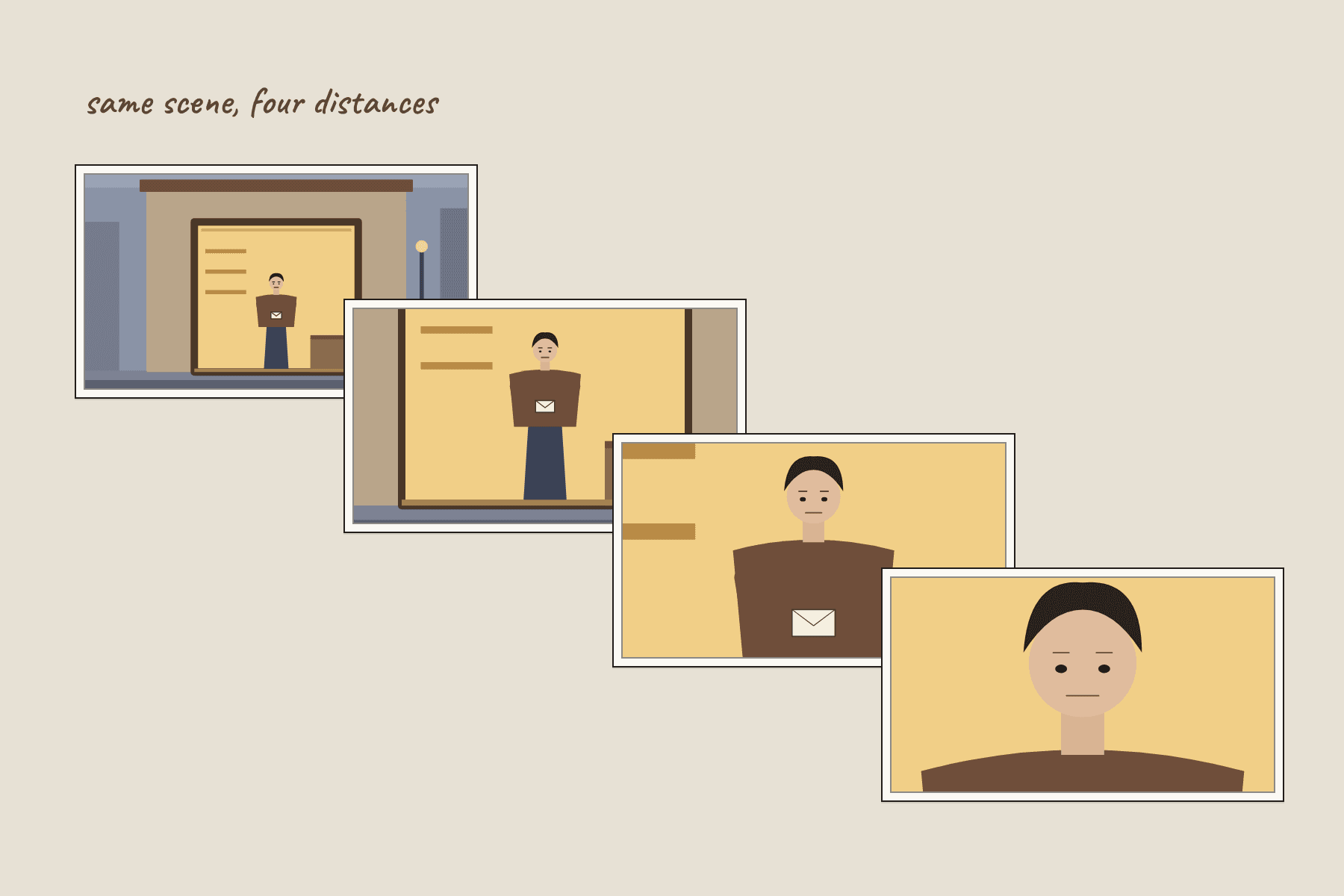
Shot sizes and what each does to a scene
What each film shot size shows and does, from extreme long to extreme close-up, drawn on one original scene, with a way to choose and a shot-list exercise.
On setGuide
Anatomy of a film call sheet: every field and why it's there
What is on a film call sheet? An annotated sample, a field-by-field table of what each part tells you, and a night-before check for actors and new crew.